As Maghull Cricket Club celebrates its centenary, this timeline offers a window into a century of community, competition and camaraderie. Drawing together recollections, records and personal contributions, it traces the club’s journey from its earliest days in 1926 through to the present.
Whilst not exhaustive, the sections that follow capture key moments, characters and milestones that have shaped the club’s identity, alongside additional sources that enrich and deepen our understanding of its history. Together, they form a tribute to all those who have played a part in sustaining and developing the club across 100 remarkable years.
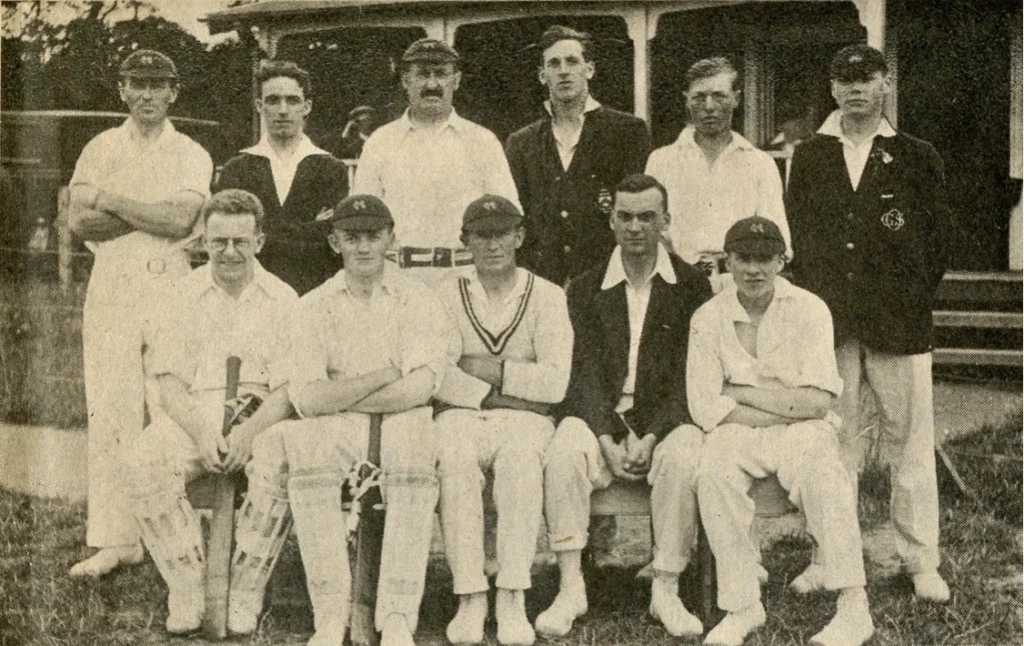
The first-ever Maghull Cricket Club XI, photographed in 1926. Captained by Tony Cropper, this group founded a club that would serve Maghull for the next century.
Back row from left: J Cropper, W E Blundell, B Davies, S Brownbill, F Swift, F Myers
Front row from left: E Pearson, S Pimbley, T Cropper (captain), G Heseltine, A Lumby
1926 – The Club is Born
Whilst some records exist of cricket being played in Maghull as early as 1914, the official foundation of Maghull Cricket Club coincided with the purchase of a field by John Pimbley, donated to the sports people of Maghull. Before this, games would rely upon the occasional loan of fields from local farmers!
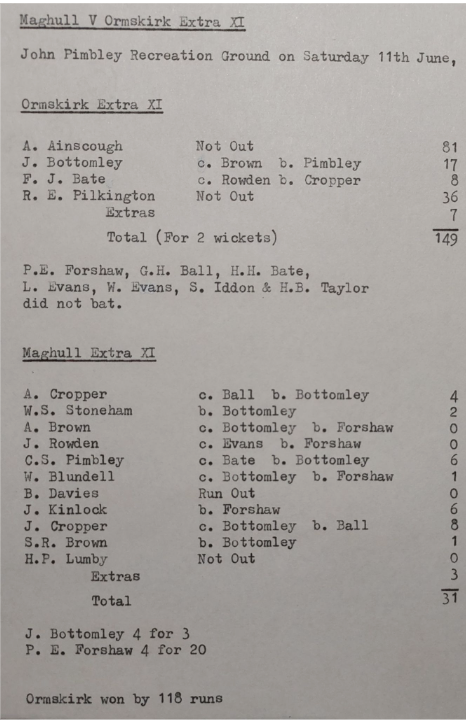
Maghull Cricket Club was founded in 1926 by local players committed to establishing organised cricket in the town. Mr E G Brownhill was the clubs first chairman, a founder alongside Tom Brakell and Tony Cropper. Playing friendly fixtures and supported entirely by volunteers, the club quickly became a cornerstone of sporting life in Maghull, playing its matches from a site on Deyes Lane. The first game took place against Ormskirk CC, alongside an official opening ceremony undertaken by Lady Vesty.
Regular matches became the norm, with 2 teams running from c. 1928 when the club joined the Ormskirk League, reaching Liverpool Competition 2nd XI standard by the 1930s.
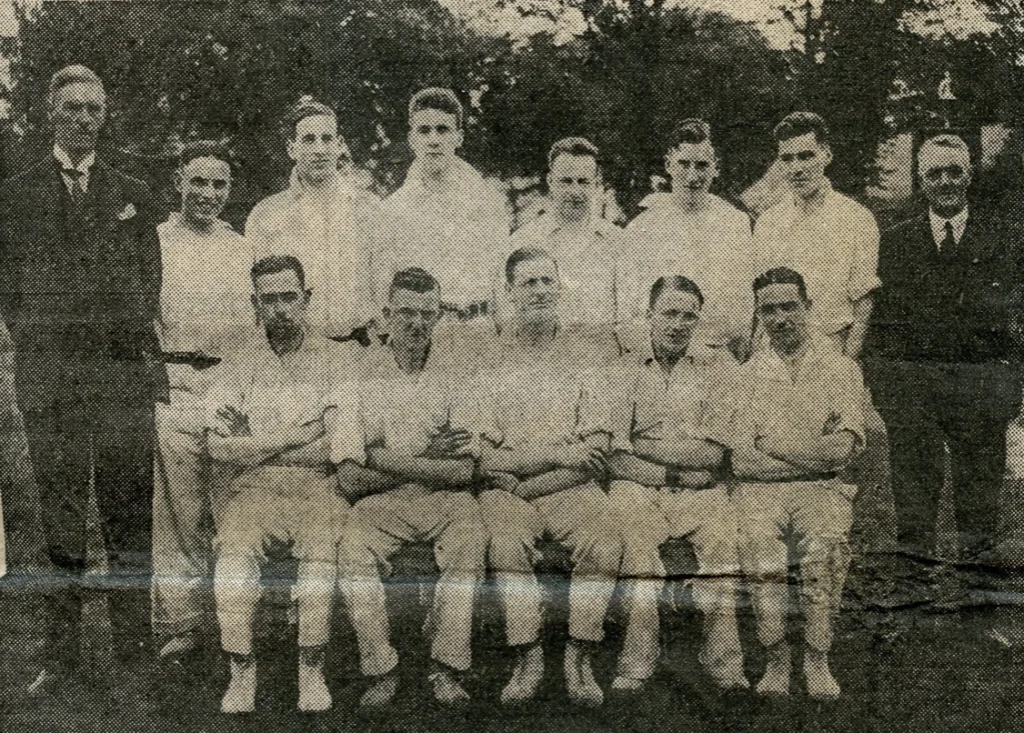
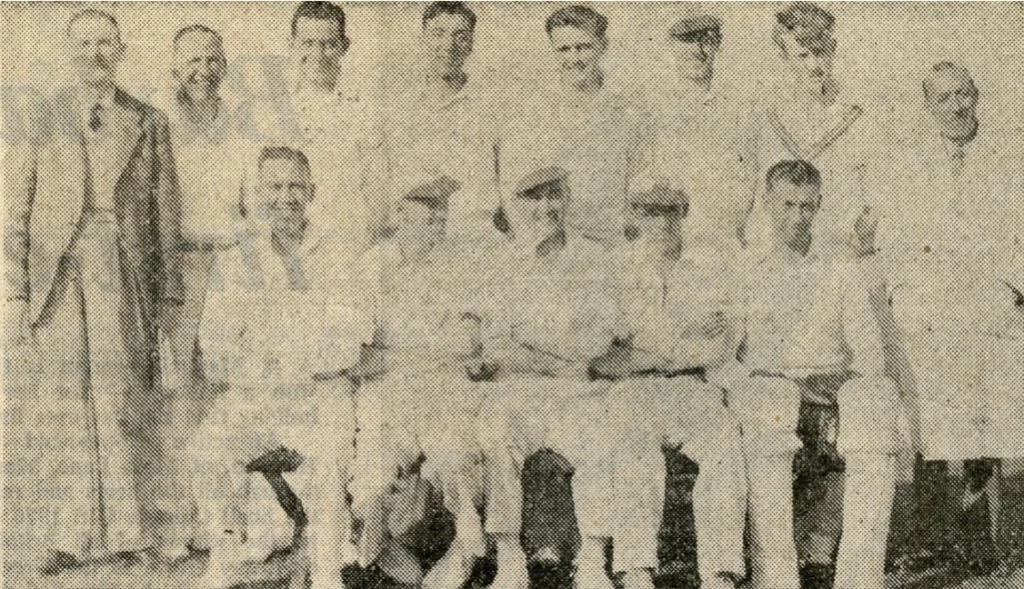
The Maghull team of circa 1935.
Back row from left: H Lumby, S Brownbill, Moulds, E Pearson, I Lumby, A Brown
Front row from left: H Moorhouse, J Roberts, W Long (captain), A Lumby, W Blundell
Umpires: J Robinson and W Dunhill
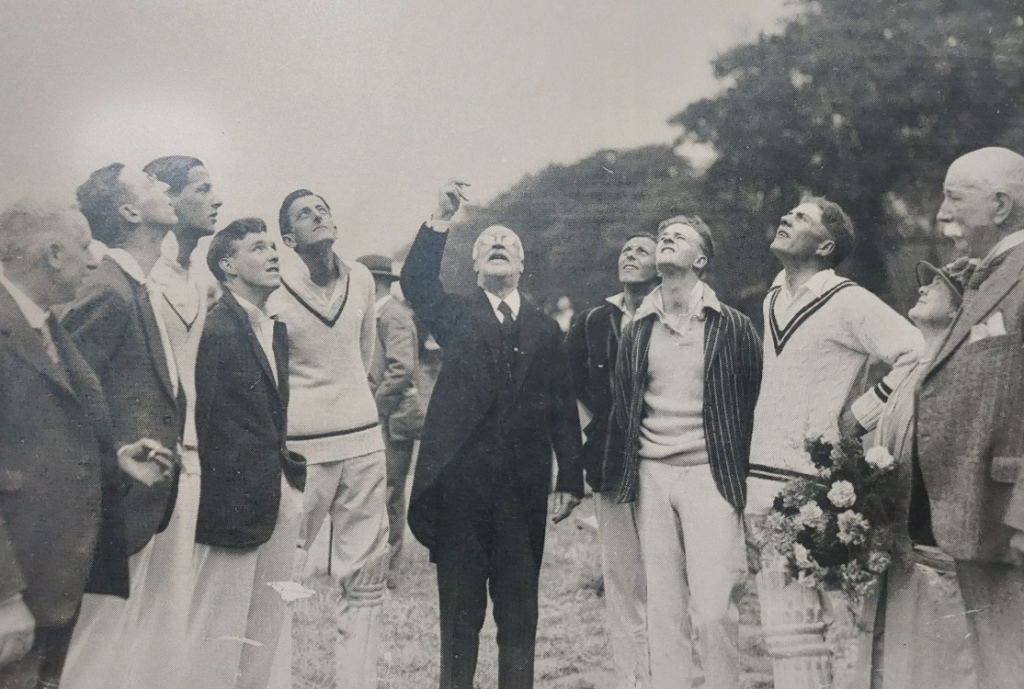
Lord Vestey tosses the coin prior to our first match, with his wife and Mr Pimbley watching on with players from the Ormskirk XI on the day.
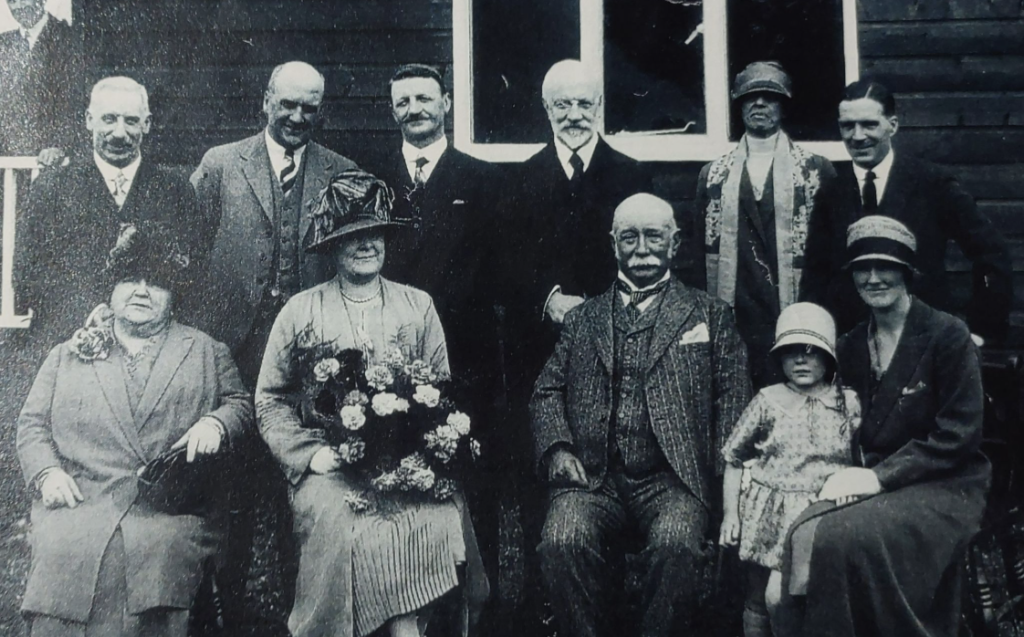
Dignitaries at the first game against Ormskirk, with John Pimbley on the front row, Lady Vestey 2nd left and Mrs Frank Hornby on the left. Lord Vestey, a former Maghull resident, stood behind Mr Pimbley.
The scorecard of the first match, a bit one-sided!
1st XI from circa 1952. Back row, from left: D. Otty, H. Cathells, J. Brett, G. Thomas, J. Whalley,
L. Balmer, F. Howell, F. Rankin
Front row, from left: H. Jesse, P. Miles, W. Whitlow (captain), F. Mills, J. Denton.
1948 – Post-War Continuity
During the 1939/45 war, the original cricket field was requisitioned for military use. The ground had received no attention during the war years and was, in fact, no further use as far as cricket was concerned, for a footpath had been worn almost directly through the actual playing area and a large garage built on the outfield. The winter of 1947 brought about the revival of the club when a public meeting was called under the chairmanship of Mr. W. E. Long. He was, for many years before the war, the popular playing captain of the club.
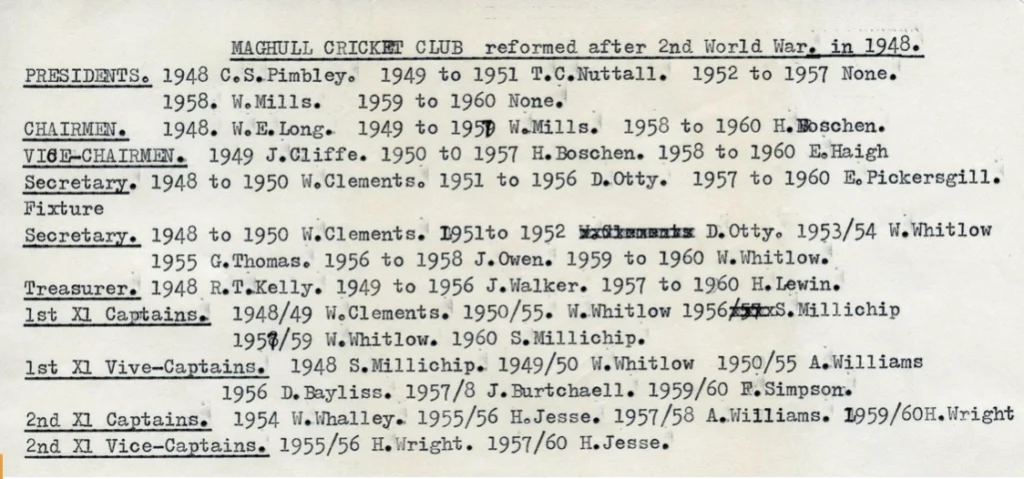
In 1948 Mr. W. Clements was elected both secretary and captain, and it was largely due to his enthusiastic efforts that the club made such a successful revival. The cricket club found a temporary home at the site of Deyes High School from 1948 to 1953 and moved to the present ground, Old Hall Field in Hall Lane, in 1954, when the 2nd XI restarted with sufficient membership to again sustain 2 teams.
This truly picturesque ground is leased by the Club from Maghull Town Council to this day. The former parish council having purchased the Old Hall Field from Mr. Sam Boyer. The original pavilion at Old Hall was purchased from H.M. Forces as a wooden barracks hut and was diligently maintained by members throughout the 50s and 60s.
Some of the clubs earliest surviving records, summarising key position holders when the club reformed after World War II
1970s – League Cricket and New Sports at Old Hall Field as our Golden Jubilee approaches
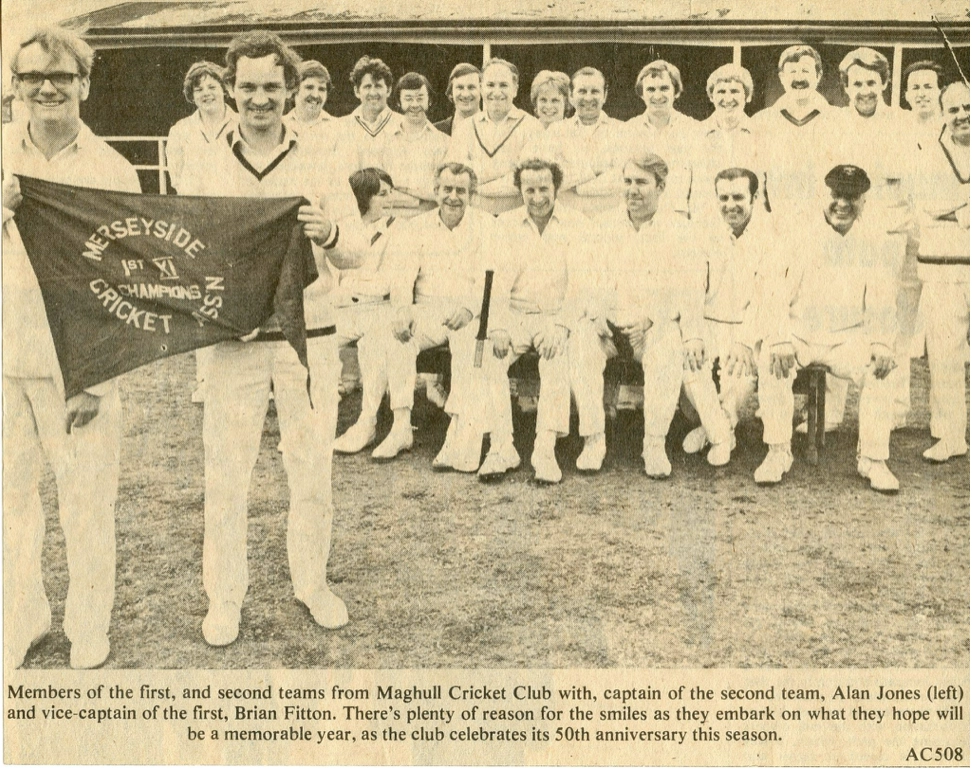
Whilst the club membership could sustain the pavilion and all of the activities associated with the game, opportunities for fixtures began to dwindle, as local teams joined various established leagues to test their mettle. As a result, Maghull became a founding member of the Merseyside Cricket Association in 1970. The MCA was seen as the 3rd premier cricket league on Merseyside.
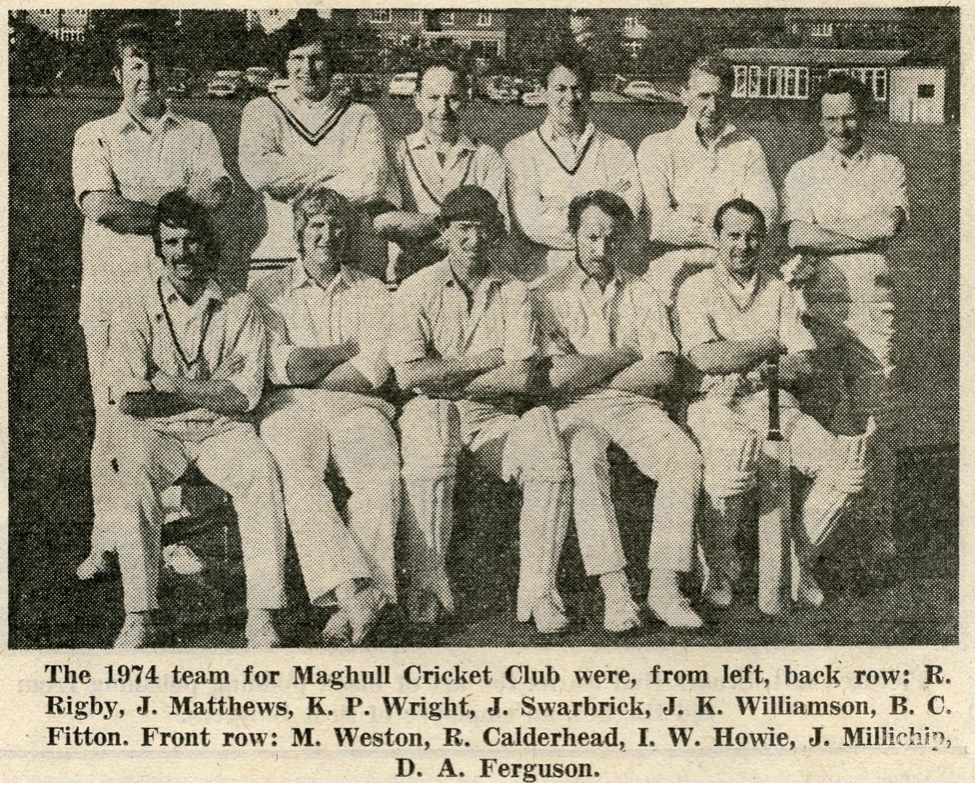
Success followed, with league championships for the 2nd XI in 1974 and the 1st XI in 1975. Cup success also came in 1974 for the club, taking the MCA knockout cup for the first time.
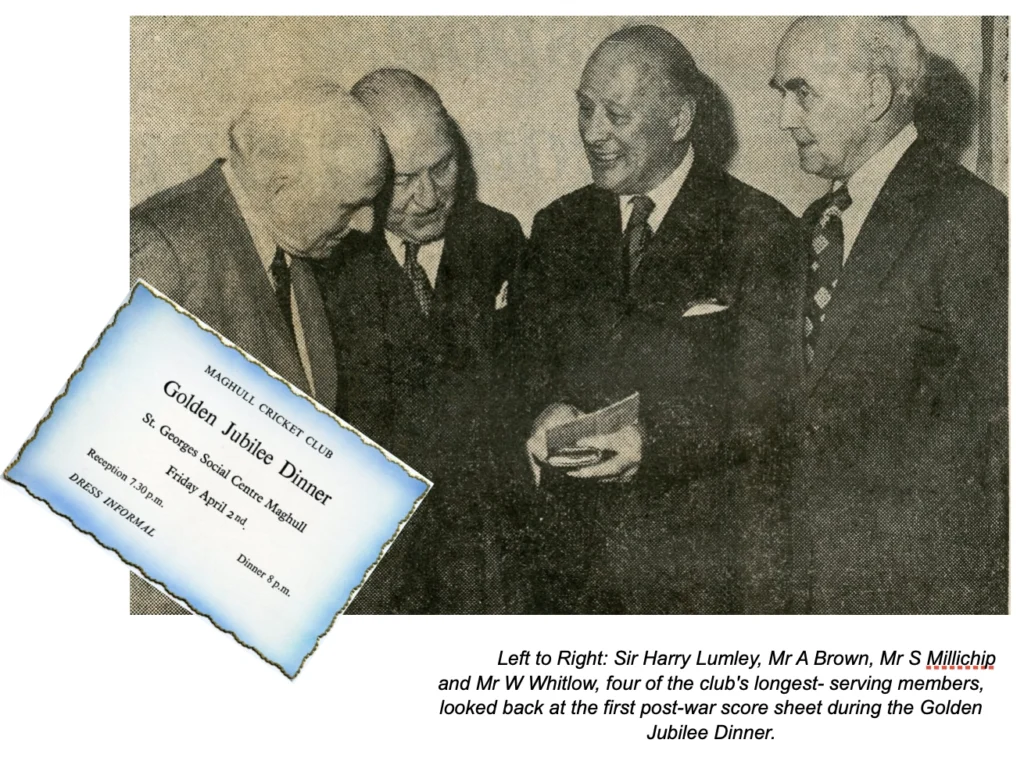
On field success coincided with the Golden Jubilee for Maghull CC. A gala dinner was held on 2nd April 1976 at St George’s Social Centre, with 142 members joined by the Mayor and Mayoress of Maghull for an evening of celebration, with a 3-course meal, cabaret, dance and speeches to entertain current and past players alike.
Whilst the cricket club ‘lifted the bat’ for an unbeaten half century, other sports joined Cricket and Football on the playing fields of Old Hall. Maghull Archery Club were regular users of the grounds, with Maghull Ladies’ Hockey Club using the outfield and pavilion during the winter from 1974/5.
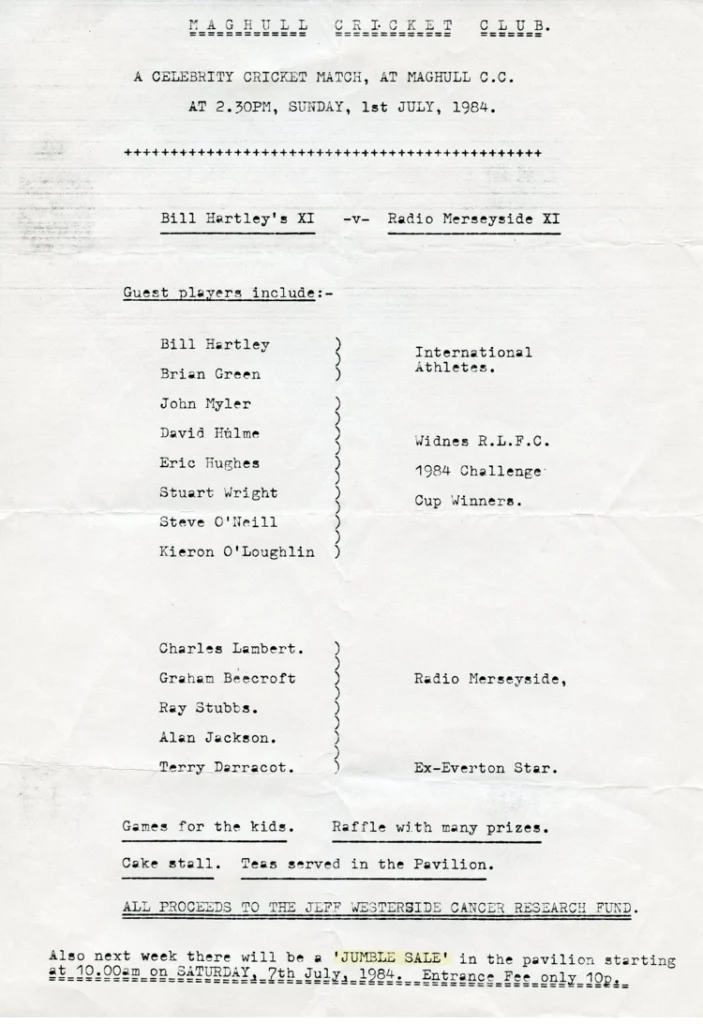
Local celebrities joined us before the fire for a charity match in July of 1984.
1980s and 90s – The Southport & District Amateur Cricket League and arising from the ashes
The 1980s saw new challenges for the club, most notably, in the latter part of 1984 when a fire destroyed the pavilion at our Old Hall Field base. Fundraising efforts alongside the insurance payout meant the club’s current facility was able to be built on the site, which was opened by none other than the Liverpool comedy legend Ken Dodd.
The move to the S&D ACL in 1979 saw new challenges too, not to mention new opponents, some of whom would eventually be adversaries in the Liverpool & District Cricket Competition in the future. The club was able to consolidate and hold its own within the league winning success throughout the period. In the league, the 1st XI were first year Division 3 winners in 1979 and went onto be Division 2 winners in 1995, whilst the 2nd XI won their divisions (Div 5) in 1979 and followed that up with Division 4 in 1980. Later, the introduction of additional teams provided more honours, with the 3rd XI winning their first league title in 1993. Cup success came in the Sandhurst Shield in 1989 for the 1st XI, the Pochin Cup for the 2nd XI in 1998 and Leyland Trophy victories for the 3rd XI in 1996 and the 4th XI two years later.
Charity was needed closer to home after the fire, with a first visit from Ken Dodd helping us along.
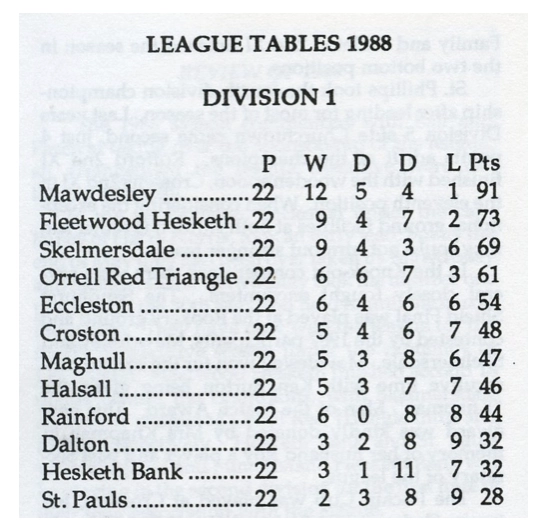
A period of consolidation: The club’s finishing position in 1988, as shown in the final league table above, maintained our place in the top division into the 90’s.
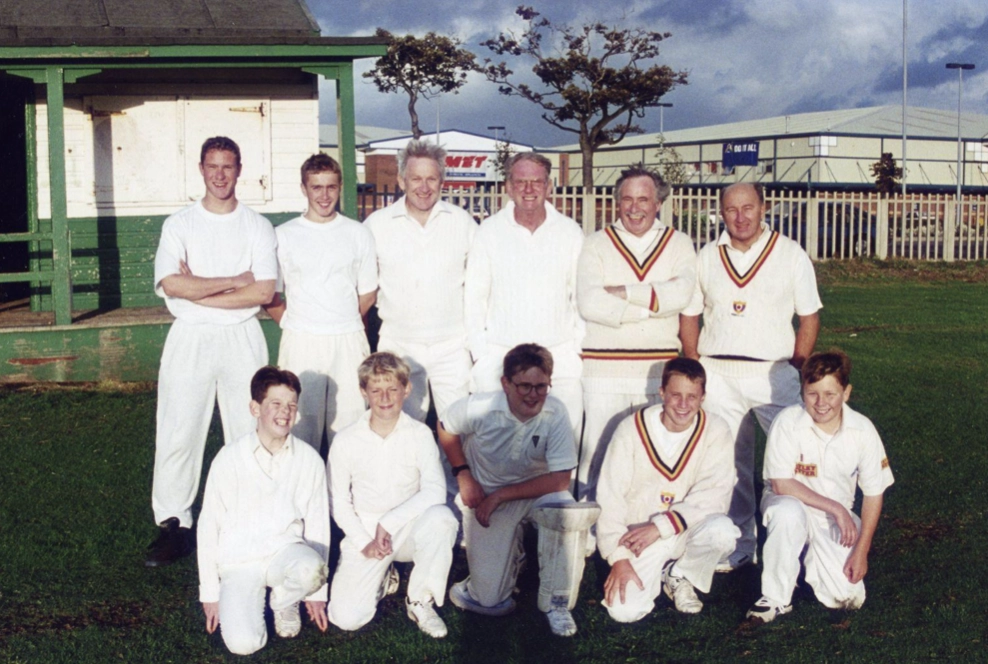
A circa 1993 photo of the 3rd XI at Meols Cop in Southport, showing a mix of youth and ‘experience’.
1989 Sandhurst Shield Winners.
Back row from left: G Keeley, R Gregson, P Ruane, S Forrest, P Griffin, P Weston, M Fitton, A Doyle (Scorer)
Front row from left: J Forrest, S Barlow, T Barlow, J Butterworth, P Johnson, D Barlow, P Anderson
1999 onwards – ‘Comp’ Cricket arrives at Maghull
Since the turn of the millennium, the club has played within the Liverpool and District Cricket Competition, becoming a full member in 1999. We have enjoyed sustained success across all senior teams since arriving in ‘the comp’. The 1st XI have secured three First Division titles, while the 2nd XI have combined league success with strong cup performances, including a First Division championship and multiple finals appearances.
The 3rd XI have been particularly consistent, claiming several league titles alongside cup honours, and the club’s depth is further reflected in competitive performances across the lower XIs.
Together, these achievements underline the strength, continuity and collective contribution that have characterised the club in the modern era.